
'Was the five-day pause ever meant to hold, or was it simply another instrument of signaling, of positioning, of buying time in a war where even the pauses are tactical?' asks Prem Panicker in his must read daily blog on the Gulf War.

Over 50 per cent, or 660 stocks, from the BSE 1000 index recorded negative returns during CY25.

The continued MF buying has pushed the equity holding of MFs to over Rs 50 trillion for the first time.

Largecap equity funds remain suitable for conservative and moderate risk-taking investors seeking relatively stable returns.

'The day is not too far when the share of MFs alone will be greater than that of foreign institutional investors.'

Since the first Reit listing in 2019, the sector has grown to a market capitalisation of about $18 billion as of August 2025, and is projected to cross $25 billion by 2030.

Exporters of gems and jewellery have said the free-trade agreement (FTA) has brought relief to their sector because this opens up the world's second-largest market and brings them on a par with China and Thailand, which face zero tariffs on shipments to Europe.

The India-EU free trade deal could help Indian-made cars enter Europe at lower costs and challenge Chinese dominance.

The growth was led by family-owned companies and business groups with presence in pharmaceuticals, information technology services, and consumer products.

Country's startups are carving a unique path by prioritising local, application-led innovation over the global pursuit of scale.

The recent evolution in the passive space has given rise to a new category of funds promising to deliver "active" returns through a structured passive approach. These are often referred to as smart beta or factor-based index funds, and they represent a compelling middle ground for investors.

Markets regulator Sebi will soon set up a working group to undertake a comprehensive review of short selling and the Securities Lending and Borrowing (SLB) frameworks, its chairman Tuhin Kanta Pandey said on Friday. The framework for short selling, introduced in 2007, has largely remained unchanged since its inception.

Largecap equities are less volatile than mid- and smallcap stocks, making them suitable for risk-averse investors.

Private sector banks slipped in market capitalisation (mcap) during the July-September quarter, underperforming their government-owned peers as trade uncertainties dragged market sentiment, said S&P Global Market Intelligence. According to its analysis, HDFC Bank shed 4.8 per cent in mcap during the third quarter, while ICICI Bank's dropped 6.7 per cent.

Investors seeking higher returns at relatively higher risk should consider allocation to smallcap equity funds.

Tata Consultancy Services (TCS), the country's largest player in information-technology (IT) export, has seen a sharp decline in its contribution to the Tata group's market capitalisation in recent years though it remains the most valuable company in the conglomerate. Its 44.8 per cent share in the combined market capitalisation of the listed Tata group companies is the lowest since March 2009 and is down sharply from the all-time high contribution of 74.4 per cent at the end of March 2020.

The country's largest listed auto parts company by market capitalisation, Samvardhana Motherson International, reported a better than expected operating performance in the second quarter (July-September) of 2025-26 (Q2FY26). Though the global passenger vehicle (PV) market is facing multiple headwinds, the company is outperforming on the back of higher content per vehicle and market share gains.

Real Madrid are football's biggest earners, Liverpool best in Premier League

Investors' wealth tumbled by Rs 9 lakh crore on Friday, in tandem with a sharp decline in the domestic equity market, where the benchmark Sensex plunged 1,414 points following a bearish trend in global equities. Fresh tariff threats that ignited global trade war fears and relentless foreign fund outflows dented investor sentiment, analysts said.

'Within India, people want high-quality, personalised banking services, and the demand for such services has exploded.'

LG Electronics India made a dazzling market debut on Tuesday, ending 48 per cent higher than its issue price and surpassing its South Korean parent in market value.

'The March 19 clash between Toxic and Dhurandhar 2 should ideally be avoided.'

618 companies were part of the billion dollar club when the markets reached all-time highs on September 26, 2024. That number has fallen to 500 following a $1 trillion wipeout in India's market capitalisation amid relentless selling by FPIs.

Packaged food major Nestle India posted better than expected September quarter results led by strong volume growth across its key segments. While there were margin pressures due to elevated raw material costs, there could be some relief with easing prices in the near term.

Tata Steel and Tata Motors dropped over 10 per cent each. Larsen & Toubro, HCL Technologies, Adani Ports, Tech Mahindra, Infosys, Tata Consultancy Services, Reliance Industries and Mahindra & Mahindra were the other big laggards.
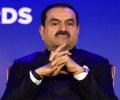
The Adani group, which operates across multiple infrastructure sectors, with 12 listed entities in India and a combined market capitalisation of about $200 billion, remains "anchored by strong assets and robust cash flows", according to a Bank of America (BofA) report.
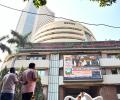
'BSE has facilitated nearly Rs 35 trillion in capital raising across multiple segments.'

The implication of April 2 reciprocal tariffs on global trade, trends in overseas markets and trading activity of foreign investors would dictate equity investors' sentiment in a holiday-shortened week ahead, according to analysts. Stock markets would remain closed on Monday for Eid-Ul-Fitr.

The ratio of market capitalisation to gross domestic product (GDP) in India remains elevated despite the recent correction in the equities markets. It was 147.5 per cent on December 3, 56 per cent higher than the 10-year average of 94 per cent. The current ratio is slightly lower than the all-time high ratio of 154 per cent at the end of September this year.

Capital markets regulator Sebi has extended the deadline for implementation of rules related to mandatory confirmation or denial of market rumours by the top 100 listed companies. The deadline has been extended for the top 100 listed companies by market capitalisation to June 1 from February 1 this year at present, according to a circular by the Securities and Exchange Board of India (Sebi). For the top 250 listed entities, the rule will kick in on December 1, 2024, from the current requirement of August 1, 2024.

'The frenzy for gold is primarily due to the uncertainty surrounding the tariff war.'

'Solutions developed in India are being commercialised and offered globally because we're executing at scale, creating new markets and revenue streams.'

While gold continues to provide safety after its strong 2025 rally, well-chosen real estate investments held with a long-term view remain attractive.

Naukri.com-parent Info Edge, whose long-term bets on Indian startups ranging from Zomato to Policybazaar yielded blockbuster returns, has been named the country's most successful venture investor, cementing its reputation as a standout player in India's startup ecosystem. The firm, helmed by Sanjeev Bikhchandani - often referred to as India's Warren Buffett- invested a total capital of Rs 3,959.16 crore across platforms over the last one and a half decades.
Starting January, the market is expected to welcome models like the Tata Punch 2025 which is expected to be around 6 lakh, Mahindra BE 07 EV around 29 lakh, Maruti WagonR Electric around 8.5 lakh, Toyota 3-Row SUV around 14 lakh, and Volkswagen Tera to be around 8 lakh.

Currently, India has five publicly listed Reits: Brookfield India Real Estate Trust, Embassy Office Parks Reit, Mindspace Business Parks Reit Nexus Select Trust, and Knowledge Realty Trust.

'It has got to be the biggest error in aviation. If it is the biggest error, then all those individuals in positions of power should be removed because they have caused the biggest meltdown in Indian aviation history.'

'The outlook for the next Samvat is more constructive, as many of the earlier drags are gradually becoming supports.'

'Bank has a robust capital adequacy base. Along with balance sheet preparation, the bank is focusing on strengthening risk management for the new regime.'

Indian equity benchmarks rose nearly 2 per cent on Thursday, capping a truncated trading week with their strongest weekly performance in over four years. The rally was sparked by renewed risk-on sentiment following progress in trade negotiations and expanded tariff exemptions.
